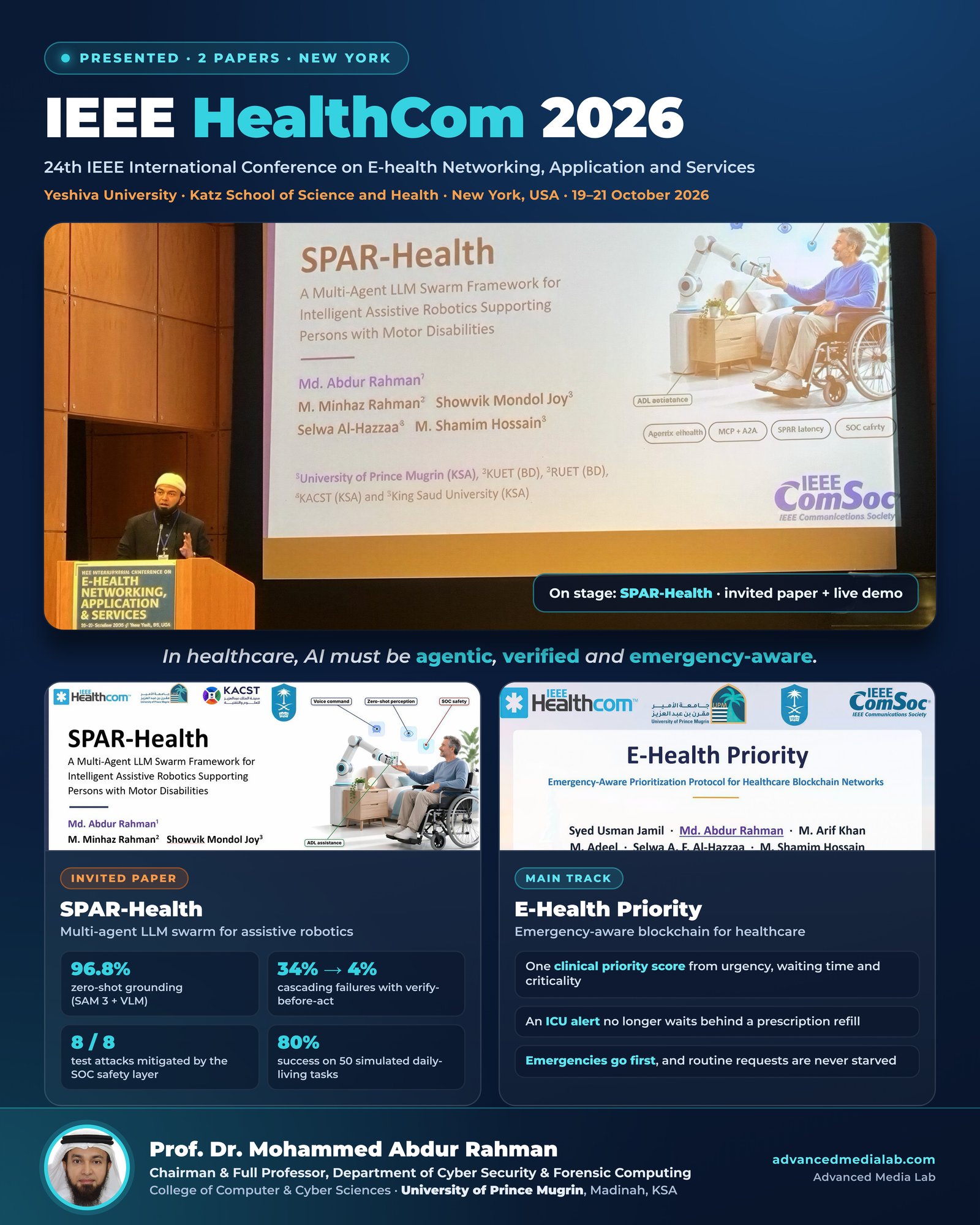
Prof. Dr. Mohammed Abdur Rahman presented two papers at the 24th IEEE International Conference on E-health Networking, Application and Services (IEEE HealthCom 2026), hosted at Yeshiva University, Katz School of Science and Health, New York, USA. The message: in healthcare, AI must be agentic, verified and emergency-aware.
SPAR-Health: a multi-agent LLM swarm for assistive robotics (invited paper)
A person with a motor disability says what they need; a swarm of specialised agents sees, plans, verifies and acts.
He showed the running prototype end to end. Asked for a “magenta box” it cannot pick, the agent explained and asked instead of guessing. Given a valid request, it called an MCP tool, the camera found the object, MoveIt2 planned the motion and the Franka arm completed the pick in ROS-2/Gazebo.
Agents propose, verification decides, then the robot moves.
E-Health Priority: emergency-aware blockchain for healthcare (main track)
An ICU alert should not wait behind a prescription refill. Each transaction gets one clinical priority score from urgency, waiting time and criticality, so emergencies go first and routine requests are never starved — making the distributed ledger clinically aware.
The future of digital health is not one bigger model. It is many accountable agents on infrastructure that knows an emergency when it sees one.
- C91 — Md. Abdur Rahman, M. Minhaz Rahman, Showvik Mondol Joy, Selwa Al-Hazzaa, M. Shamim Hossain, “SPAR-Health: A Multi-Agent LLM Swarm Framework for Intelligent Assistive Robotics Supporting Persons with Motor Disabilities,” IEEE HealthCom 2026 (invited paper).
- C95 — Syed Usman Jamil, Md. Abdur Rahman, M. Arif Khan, M. Adeel, Selwa A. F. Al-Hazzaa, M. Shamim Hossain, “E-Health Priority: Emergency-Aware Prioritization Protocol for Healthcare Blockchain Networks,” IEEE HealthCom 2026 (main track).
Thanks to the co-authors: M. Minhaz Rahman (KUET), Showvik Mondol Joy (RUET), Professor Selwa A. F. Al-Hazzaa, MD, FRCS, MMM (KACST), Prof. M. Shamim Hossain (King Saud University), Syed Usman Jamil (Edith Cowan University), M. Arif Khan (Charles Sturt University) and M. Adeel (UNT Dallas); and to the HealthCom 2026 organizers, Yeshiva University, IEEE ComSoc and the University of Prince Mugrin.
Back to News